

Latest News
Bianca Chaves Receives Quentin Mees Research Award at AZ Water 2026

May 4, 2026
Bianca Chaves, Water Resiliency Program Coordinator and Research Scientist at the University of Arizona’s WEST Center, received the Quentin Mees Research Award at the AZ Water Association’s 99th Annual Conference & Exhibition, held April 28–30, 2026, at the Phoenix Convention Center. The award recognized the publication “Extending the Life of Water Reuse Reverse Osmosis Membranes Using Chlorination,” co-authored with Mohammed Alhussaini, Varinia Felix, Luke Presson, Walter Betancourt, Kerri Hickenbottom, and Andrea Achilli. The Quentin Mees Award highlights outstanding research contributions that advance the water industry and promote innovative solutions in water treatment and reuse. The paper can be found here: https://doi.org/10.1016/j.memsci.2021.119897
AZ Water plays a key role in advancing water research and practice. Chaves’ recognition reflects both the impact of her team’s work and the continued leadership of the WEST Center in developing practical, high-impact solutions for water sustainability.
Arianna Tariqi Awarded ARCS Foundation Scholarship

Apr 28, 2026
We are proud to share that Arianna Quinn Tariqi, a member of the Water Resiliency Program working in Dr. Kerri Hickenbottom’s research group, has been awarded the Achievement Rewards for College Scientists (ARCS) Foundation – Phoenix Chapter Scholarship for the 2026–2027 academic year. Arianna attended the scholarship dinner alongside fellow graduate students from the University of Arizona College of Engineering, where she engaged with ARCS donors and awardees, presented her research during a poster session, and shared an overview of her work with the audience. We congratulate Arianna on this well-deserved recognition and are grateful for her contributions to the Water Resiliency Program—congratulations, Arianna!
Congratulations to Reema Shinh and Hercílio Zimila for their achievements at the UofA College of Engineering

Apr 27, 2026
Reema Shinh, a member of the Water Resiliency Program and advised by Dr. Kerri Hickenbottom, was recognized with the 2026 Outstanding Teaching Assistant award. Hercílio Zimila, also a member of the Water Resiliency Program and advised by Dr. Eduardo Sáez, received the 2026 Outstanding Graduate Student award, in recognition of their exceptional academic achievements and contributions to the University, College, and the Department of Chemical & Environmental Engineering.
Congratulations!
Shared Water Film Screening Highlights Water Resiliency and Security

Apr 17, 2026
The University of Arizona hosted the Shared Water film screening, convening researchers, students, and community members to explore water resiliency and security in the Southwest.
The event featured Flowing Forward: Shared Water, followed by a panel discussion led by Andrea Achilli (Deputy Director, WEST Center). Panelists included Emmy-winning filmmaker Dan Druhora; Sharon Megdal (Director, Water Resources Research Center); Scott Schladweiler (Deputy Director, Tucson Water); Kerri Hickenbottom (Associate Professor, Chemical & Environmental Engineering); and Thomas Kunkel (Executive Vice President, Kyl Center for Water Policy).
The discussion highlighted the importance of water reuse, policy innovation, and cross-sector collaboration to address increasing water scarcity across Arizona and the Southwest. The event provided a valuable platform for dialogue and underscored the critical role of research, partnerships, and community engagement in advancing a more resilient water future.
WRRC 2026 Annual Conference Explores Water for Tech, Mining, and Energy

Apr 15, 2026
The Water Resources Research Center (WRRC) 2026 Annual Conference, Water for Tech, Mining & Energy: Pathways to Arizona’s Future, at the University of Arizona highlighted the growing connections between water, energy, mining, and the increasing demand from data centers in the region.
Members of the Water Resiliency Program—including Andrea Achilli, Varinia Felix, Abdullah Aleidan, Tenzin Phakdon, Reema Shinh, Mervin Lim, Kerri Hickenbottom, and Bianca Chaves—participated in the event and enjoyed engaging discussions on advancing water sustainability and resilience.
More about the Water Resources Research Center (University of Arizona): https://wrrc.arizona.edu/
NAWI Workshop – Advancing Water Treatment Science

Mar 26, 2026
On March 26, 2026, Andrea Achilli, Mervin Lim, and Bianca Chaves attended the NAWI workshop titled “Advancing Water Treatment Science to Support Regional Water and Energy Management,” held in Tempe, Arizona.
The workshop brought together leading researchers, practitioners, and policymakers to discuss advancements in desalination, water reuse, and the energy-water nexus, as well as their implications for regional water supply and energy demand. The program featured plenary presentations from leadership at the U.S. Department of Energy and the Water Infrastructure Finance Authority of Arizona, along with panel discussions from experts across the field.
A key highlight of the event was the discussion of the Water treatment Technoeconomic Assessment Platform (WaterTAP), an open-source Python-based software package developed by NAWI that supports the technoeconomic assessment of full water treatment trains. The WEST Center previously hosted a WaterTAP workshop in May 2024, reflecting its ongoing engagement with NAWI as a stakeholder in advancing water treatment innovation. Read more about the WaterTAP tool below.
WEST PhD Students Recognized at EPAZ Annual Conference
Mar 6, 2026
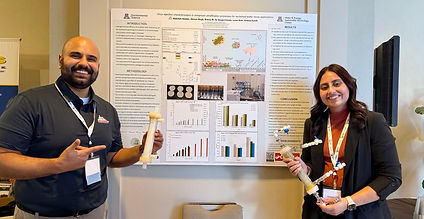
Congratulations to PhD students Abdullah Aleidan and Simran Singh, who received top honors at the Student Poster Competition during the 21st Annual Conference of the Environmental Professionals of Arizona (EPAZ), held on March 4–5, 2026. Competing among graduate students from institutions across the region, Simran Singh was awarded 1st place, and Abdullah Aleidan earned 3rd place for their research presentations.
Their posters showcased innovative research related to water and environmental resilience, reflecting the strong contributions of the WEST Center & WateResiliency Program to advancing water treatment and sustainability solutions. Abdullah is supervised by Dr. Andrea Achilli, and Simran is supervised by Dr. Luisa Ikner, both Principal Investigators in the Water Resiliency Program. The recognition highlights the high quality of student research and mentorship within the program and reinforces the Center’s commitment to training the next generation of environmental engineers and scientists.
Conference details are available at the EPAZ website.
Mervin Lim Publishes Article on Reclaiming Brine Water to Boost Supplies

Feb 4, 2026
We’re excited to share Mervin XuYang Lim's article for The Conversation U.S. about how reclaiming water from brine can help expand water supplies and reduce environmental harm.
In the piece, Mervin explains how brine presents both a challenge and an opportunity. By recovering clean water and valuable chemicals from these waste streams, we are exploring ways to increase reuse while minimizing environmental impacts. Click "Read More" to read the full article.
After the publication of the article above, KJZZ approached Mervin for an interview with summary of the aired section available online titled “Tucson project looks to capture waste from wastewater and make it a usable water source” on https://www.kjzz.org/education/2026-02-27/tucson-project-looks-to-capture-waste-from-wastewater-and-make-it-a-usable-water-source.
Let’s rethink how we manage brine and move toward more resilient, circular water systems.
ASU Professor Sergi Garcia-Segura Visits UA and Explores the STREAM System at the WEST Center

Feb 2, 2026
Sergi Garcia-Segura, Assistant Professor from Arizona State University’s School of Sustainable Engineering and the Built Environment, visited the University of Arizona on February 2, 2026, as a CHEE seminar speaker hosted by Dr. Andrea Achilli. During his visit, Sergi met with several faculty members across the department and toured key research facilities, including the Solar Site and the Water & Energy Sustainable Technology (WEST) Center. His visit provided an opportunity to exchange ideas on emerging technologies in water treatment, electrochemistry, and resource recovery, strengthening collaboration between ASU and UA researchers working in sustainable water solutions.
A highlight of the visit was Sergi’s tour of the WEST Center, where he met members of the U.S. Army–funded research team and learned more about ongoing projects, especially the STREAM system (Separation, Treatment, Recovery, via Electrochemistry and Membranes). Led by PIs Dr. Andrea Achilli and Dr. James Farrell, STREAM is an electrified universal pretreatment approach designed to recover water and valuable resources from concentrate brines. The visit fostered technical discussions around electrochemical processes, membrane integration, and the future of resilient water treatment systems. Pictured during the visit are Dr. Tenzin Phakdon, Dr. Kerri Hickenbottom, Dr. Sergi Garcia-Segura, Dr. Andrea Achilli, PhD student Mervin Lim, and Dr. Bianca Chaves.
WateResiliency Members Present Research at DESAL 2025 in Florida

Nov 20, 2025
WaterResiliency members Drs. Andrea Achilli and Bianca Chaves, along with PhD student Mervin Lim, participated in the 7th International Conference on Desalination Science and Technology (DESAL 2025), held from November 16–19, 2025, in Clearwater Beach, Florida. The conference provided an excellent platform for scientific exchange and collaboration among researchers and practitioners in water treatment and reuse.
Their presentations highlight the Water Resiliency Program’s commitment to advancing water treatment technologies, enhancing water reuse systems, and supporting resilient and sustainable water supplies. The program is conducted in partnership with the Water Reuse Consortium and supported by the U.S. Army Engineer Research and Development Center (ERDC). DESAL 2025 offered valuable opportunities for knowledge sharing, networking, and discussion of innovations in membrane technologies and water reuse strategies, reinforcing the program’s mission to develop sustainable water solutions for communities facing growing water challenges.
New Publication Sheds Light on Public Perceptions of Advanced Water Purification

Nov 1, 2025
A new peer-reviewed study led by co-PI Amanda Wilson (Thrust 6) and involving multiple PIs from the Water Resiliency Program explores how communities in the arid U.S. Southwest perceive advanced water purification — a technology increasingly considered for potable reuse. The research, published in Science of the Total Environment, examined both survey and interview data to characterize public risk perceptions and acceptance of advanced purified water compared with current tap water. Strikingly, only 36 % of survey respondents currently use their tap water for drinking, yet 42 % said they would be open to drinking advanced purified water, suggesting potential receptivity to new water resilience strategies despite lingering concerns about safety and trust.
The mixed-methods study highlights key factors that influence acceptance, including the importance of transparent communication, third-party testing, and community engagement to build trust in water utilities and treatment technologies. These insights are particularly relevant as utilities consider implementing advanced water purification to address long-term water scarcity in rapidly growing urban regions. Several Water Resiliency Program investigators contributed to this collaborative work, underscoring the program’s commitment to both cutting-edge research and community-focused approaches to water sustainability.
UA Scientists Part of $38M Water Research Effort to Shape Arizona’s Water Future
Oct 9, 2025
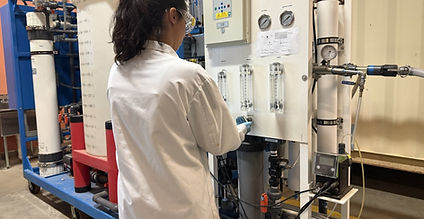
Researchers at the University of Arizona are playing a central role in a new $38 million research project aimed at developing innovative solutions to the state’s long-term water challenges. As part of the coverage, WEST Center members were interviewed by the Tucson Sentinel, sharing insights on ongoing efforts related to advanced water treatment, water reuse, and long-term sustainability across the Southwest.
The project brings together researchers, community partners, and federal agencies to develop practical, science-based strategies that strengthen regional water resiliency. This recognition highlights the importance of collaborative research in preparing Arizona for increasing water demands and climate-driven challenges.
Read the full Tucson Sentinel article by clicking “Read more.”
New Publication Advances Understanding of Organic Matter Monitoring in Water Treatment

Oct 1, 2025
A new peer-reviewed publication led by Dr. Bianca M. Souza-Chaves and Dr. Andrea Achilli, with co-authors Diego Salido Alejandri and Dr. Walter Q. Betancourt, has been published in Science of the Total Environment. The study presents innovative research on water quality monitoring relevant to water reuse and resiliency, focusing on the use of total fluorescence as a surrogate measure for organic carbon in water. This approach offers a promising, rapid, and cost-effective method for assessing organic matter during treatment processes. The findings may help researchers and water utilities better track real-time changes in water quality, supporting more resilient treatment strategies, particularly in systems implementing advanced purification and water reuse.
This publication contributes to Water Resiliency Program Thrusts 1 and 5, which emphasize improved monitoring, detection, and management of water quality to support safe potable reuse and sustainable water systems. The work highlights the importance of interdisciplinary research in addressing challenges related to emerging contaminants and the efficient operation of treatment technologies. By advancing surrogate indicators such as fluorescence, the study expands the available toolkit for managing water quality under variable conditions—an essential component of building resilient water supplies in drought-impacted regions and rapidly growing urban areas.
Documentary Screening Highlights the Future of Water in the Arid West

Sep 25, 2025
Episode 2 of the Flowing Forward documentary series, titled Shared Water, was screened as part of the University of Arizona Department of Chemical & Environmental Engineering Fall 2025 Seminar Series. The event featured a presentation by Dr. Kerri Hickenbottom, Associate Professor in the department, and took place on Monday, September 29, 2025, from 10:00 to 10:50 AM in Room 118A-A1 of the Harshbarger Building.
In Shared Water, Dr. Hickenbottom explores the complex network of partnerships that sustain the Colorado River and support communities across the arid Southwest. Directed and produced by Emmy Award–winning filmmaker Daniel Druhora, the documentary highlights how collaboration among communities, industries, and natural systems is essential to securing water resources for the future. The film is part of Flowing Forward, a cinematic series that examines innovative technologies, research, and solutions addressing growing water challenges in urban environments. The series is supported through the communication and outreach efforts of the Water Reuse Consortium, a national partnership involving the University of Arizona, the University of Southern California, the University of Nevada, Reno, and the U.S. Army Engineer Research and Development Center (ERDC).
The full episode Shared Water, as well as other documentaries from the Flowing Forward series, can be viewed through the “Read more” link below.
WEST–ERDC Partnership Propels Water Reuse for National Security

Aug 27, 2025
The WEST Center was recently featured in a University of Arizona news article highlighting its partnership with the U.S. Army Engineer Research and Development Center (ERDC) to advance water reuse technologies critical to national security and workforce development.
The collaboration focuses on developing and demonstrating advanced water treatment and reuse systems that support resilient water infrastructure, particularly for military installations and remote operations. This partnership strengthens the connection between academic research and real-world applications, helping prepare future engineers while addressing pressing water challenges.
Read the full article in "Read More".
Arizona Science (AZPM) Highlights Wastewater Recycling and Arizona’s Water Future

Aug 25, 2025
The WEST Center was featured on Arizona Science (AZPM), Episode 378, which explored whether wastewater recycling can help address Arizona’s long-term water challenges. Dr. Andrea Achilli, Deputy Director of the WEST Center, was interviewed during the episode, sharing expert insights on advanced water treatment and water reuse technologies. The discussion highlights the role of innovative reuse strategies in supporting long-term water sustainability across Arizona.
Listen to the full episode by clicking “Read more.”
Water Resiliency Program Publication Advances Understanding of Virus Measurement in Water Treatment

Aug 5, 2025
A new peer‑reviewed study co‑authored by Dr. Walter Q. Betancourt has been published in Journal of Virological Methods, contributing to Water Resiliency Program Thrust 5—Detection and Attenuation of Viruses. The research, titled “Influence of virus analytical methods on the estimation of virus reductions by ultrafiltration,” evaluates how different analytical approaches affect the quantitative measurement of viruses and their reduction during ultrafiltration treatment processes.
In this work, the authors compared virus concentration and detection methods—including centrifugal ultrafiltration and the InnovaPrep CP Select™ Concentrating Pipette—as well as digital PCR and plaque assays for quantifying viruses in recycled water before and after ultrafiltration. The study found that commonly used analytical procedures can yield highly variable virus reduction estimates depending on the method and water characteristics, highlighting the need for carefully tailored measurement techniques to accurately assess pathogen removal performance in advanced water purification systems. These insights are instrumental in improving virus monitoring and ensuring the effectiveness of treatment barriers for potable reuse applications, supporting the Water Resiliency Program’s mission to enhance pathogen detection and water quality safety.
Advanced Water Purification Workshop Brings West Point Cadets to WEST Center

Jul 10, 2025
From June 30 to July 10, the University of Arizona’s WEST Center hosted cadets from the United States Military Academy at West Point for an immersive, hands-on training in advanced water treatment and reuse. This two-week course was part of the West Point Water Reuse Field School and was developed through the Water Resiliency Program.
The workshop blended classroom instruction with lab-based practice, allowing cadets to explore real-world applications of cutting-edge water technologies. Each treatment system was introduced through focused lectures to establish foundational knowledge, followed by hands-on sessions where cadets operated ultrafiltration, reverse osmosis, advanced oxidation processes, granular activated carbon, and disinfection systems.
In the first week, cadets worked under instructor supervision using tap water to familiarize themselves with each system. The second week emphasized independent application, where cadets conducted experiments using reclaimed water from the Agua Nueva Water Reclamation Facility. The curriculum also included water quality testing and field tours of the Agua Nueva Water Reclamation Facility and a hybrid concentrated solar power/photovoltaic membrane distillation pilot system.
Instruction and site guidance were led by water reuse experts from the Department of Chemical and Environmental Engineering, the Department of Environmental Science, and collaborating organizations. We thank Dr. Eduardo Saez, Dr. Itzel Marquez, Dr. Bianca Miguel de Souza Chaves, Dr. Luisa Ikner, Dr. Varinia Felix, Dr. Luke Presson, Hercilio Zimila, Violeta Martinez, Jeb Shingler and Minna Allouzi, for their contributions.
UArizona Student Wins Award at AEESP 2025 Research and Education Conference

May 21, 2025
Jeb Schingler, a PhD student in Environmental Engineering at the University of Arizona and member of the Hickenbottom Environmental Research (HER) Lab, presented his poster titled "Advancement of Zero-Liquid Discharge with a Hybrid Optical Desalination Technology for Brine Concentrate Management" at the Association of Environmental Engineering and Science Professors (AEESP) 2025 Research and Education Conference, held at Duke University's campus in Durham, North Carolina. His work received the Best Poster Award – Student Category, highlighting innovative approaches to concentrate management with a focus on sustainability, circularity, and self-sufficient off-grid systems.
UArizona Students Win Awards at AZ Water 98th Annual Conference

Apr 16, 2025
Students from the WateResiliency Program participated in the AZ Water 98th Annual Conference & Exhibition held at the Phoenix Convention Center on April 15, 2025. Congratulations to Mervin Lim and Arianna Tariqi for earning 2nd and 3rd place, respectively, in the Annual Student Poster Competition!
Mervin, advised by Dr. Andrea Achilli, presented “Universal Pretreatment System to Achieve High Water Recovery from Concentrated Brine”, co-authored with Tenzin Phakdon, Andrea Achilli, and James Farrell.
Arianna, advised by Dr. Kerri Hickenbottom, presented “Reverse Osmosis and Nanofiltration: A Hybrid Approach for Brackish Water Desalination”, co-authored with Anthony Straub, Luis Cruzado, Kerri Hickenbottom, and Vicky Karanikola.